Loading guide…
Find your baby's PurePail size, see the range, and learn where this newer diaper brand fits in.

PurePail is a newer entrant best known for its diaper-pail system, with a diaper line designed to pair with it. It runs a single everyday line, so sizing is simple, though it skips the newborn stage.
This guide covers the full PurePail range, what to expect at each size, how much to buy, and how its sizing compares to other brands. Use the finder above to match your baby's weight, then read on for the details.
Find the right fit by weight
PurePail covers Size 1 through Size 6 with one line, using the standard US weight ranges so sizes match other brands and you go by weight. The ranges overlap, so a baby can wear two sizes during a growth phase; let the leg fit decide which to use.
The gaps are at both ends: there is no Newborn size, so the early weeks need another diaper, and there is no Size 7. In between, PurePail spans the bulk of a baby's diapering years with a single everyday diaper that handles both day and night.
| Size | Weight |
|---|---|
| Size 1 | 8–14 lbs |
| Size 2 | 12–18 lbs |
| Size 3 | 16–28 lbs |
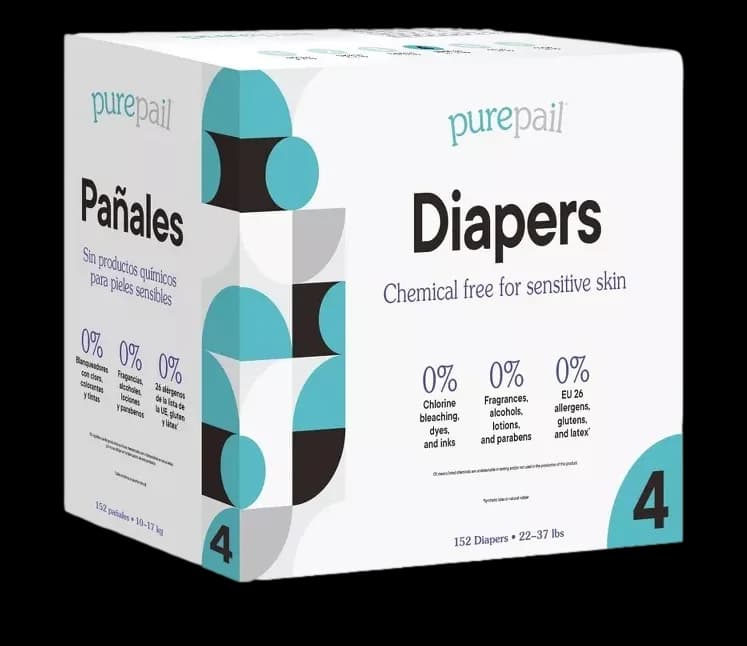
| Size 4 | 22–37 lbs |
| Size 5 | 27+ lbs |
| Size 6 | 35+ lbs |
PurePail does not make a Newborn size, so the first weeks are covered by another diaper. Once your baby reaches roughly eight pounds and Size 1, you can move onto PurePail, often around when the newborn change pace begins to settle.
Size 2 and Size 3 carry most of the first year, with Size 3 the long-running size. As a single line, the only adjustment you make is the number, and Size 3 is the one to buy in larger quantities.
From Size 4 to Size 6, changes slow and get heavier. PurePail covers this stretch but stops at Size 6, so a toddler who grows into Size 7 will need another brand for the final stage. For nights, sizing up one is the usual approach, since there is no dedicated overnight diaper.
Size coverage by product line
With a single line from Size 1 to Size 6, there is nothing to choose between; the everyday diaper handles day and night. Plan a Newborn diaper for the first weeks and a Size 7 elsewhere if your toddler outgrows Size 6. The grid above shows the Size 1 start and Size 6 finish.
Estimate your diaper budget
PurePail is priced in the mid range, in line with other mainstream diapers. The estimator above shows your cost across a year so you can compare it against your current diaper. As a single line, there is one price to plan around.
If you use the matching pail system, factor the cost of refills into your overall diapering budget alongside the diapers themselves, since the two go hand in hand and a pail is only as convenient as its refill supply. Because the per-diaper price holds across the range, your cost does not spike as your baby grows into larger sizes, so the monthly figure stays predictable from Size 1 through Size 6.
You skip the newborn stockpile with PurePail, since it starts at Size 1. Begin modestly at Size 1, buy a little more at Size 2, then stock up at Size 3, the longest-worn size. From Size 4 to Size 6, reorder steadily, and keep a reserve pack of the next size up for growth spurts. If you use the matching pail system, factor refills into your regular reorder so diapers and refills arrive together.
PurePail starts at Size 1, so the first sizing decision is when to start: use another diaper for the newborn weeks and move over around eight pounds, when your baby reaches Size 1 and the newborn change pace begins to settle. Weigh your baby every couple of weeks through the early months and go by weight, which is when transitions come fastest. The single line covers Size 1 to Size 6, so from there you only change the number.
Use the size overlap to handle nights. PurePail has no dedicated overnight diaper, so for a heavy night wetter, size up one for sleep and keep the snugger size for daytime changes, where a closer fit prevents leg and back leaks. Try a single size up for a few nights before assuming it is not enough; for most babies the extra capacity is plenty to reach morning.
If you use PurePail's matching pail system, fold diaper reordering and pail refills into one routine so they arrive together and you never run short of either. Plan around the Size 6 ceiling with a Size 7 alternative for a larger toddler, keep early sizes lean since they pass quickly, and concentrate your buying at Size 3, the longest-worn size. Keep a reserve pack of the next size up for growth spurts, and use the two-finger waistband test plus a clean leg seal to judge when to move up.
PurePail runs true to size. With one line, the only sizing job is to track your baby's weight and step up when the fit tightens. Look for tabs at the center, a clean leg seal, and no marks. The checklist above helps you judge. Note the Size 1 starting point, which means the newborn fit is handled by another diaper.
Is it time to size up?
Check any fit warnings that apply to your baby:
Good fit
If the diaper is dry and comfortable, you are in the correct size.
Switching to PurePail is straightforward once your baby is in Size 1, since it uses the standard weight chart and your size number carries over. Plan around the missing Newborn size by starting on another brand and moving over around Size 1, and around the Size 6 ceiling by lining up a Size 7 alternative for a larger toddler. Judge the fit by weight and the usual signs over the first few days.
The first PurePail mistake is expecting a Newborn size. It starts at Size 1, so plan another diaper for the early weeks and switch around eight pounds. The mirror mistake is at the top: PurePail stops at Size 6, so a larger toddler needs a Size 7 alternative ready before the last pack runs out.
A third pitfall, common with single-line brands, is looking for a PurePail overnight diaper; there is not one, so size up for sleep if mornings are wet rather than searching for a line that does not exist. A fourth, specific to PurePail, is letting diapers and pail refills fall out of sync if you use the matching system; fold both into one reorder so you never run short of either. The everyday fundamentals still apply: do not overstock the small sizes, do not blame leaks on the diaper when a slightly-too-big fit is the usual cause, and concentrate buying at Size 3, the longest-worn size. As always, weigh your baby and go by weight rather than age, moving up when tabs no longer reach the center or the leg seal fails.
See how PurePail compares with the alternatives parents most often consider.
| Spec | PurePailDiapers | CutiesComplete Care Diapers | HuggiesLittle Movers | HuggiesSnug & Dry |
|---|---|---|---|---|
| Price / diaper | $0.45 | $0.35 | $0.42 | $0.33 |
| Rating | 4.6 | 4.3 | 4.7 | 4.6 |
| Type | Everyday | Everyday | Everyday | Everyday |
| Material | — | cotton | — | polyester |
| Blowout guards | No | No | Yes | Yes |
| Wetness indicator | No | No | Yes | Yes |
| Hypoallergenic | No | Yes | Yes | Yes |
| Fragrance-free | Yes | Yes | Yes | Yes |
| Eco-friendly | No | No | No | No |
PurePail is a sensible everyday diaper, especially if you already use its pail system, from Size 1 to Size 6. Keep the size current, buy your bulk at Size 3, and it does the job.
Comparing brands? Browse our other diaper size guides to see how the fit and sizing stack up.
PurePail covers Size 1 through Size 6. There is no Newborn size and no Size 7.
Yes. They use standard US weight ranges, so match your baby's weight and size up at the first sign of marks or leaks.
Because PurePail starts at Size 1, you will need a Newborn diaper from another brand for the early weeks, then switch around eight pounds.
No. PurePail is a single everyday line; parents with heavier overnight needs often size up one for sleep.
Size up when tabs no longer reach the center, leaks appear, or the waistband marks the skin. Overlapping ranges mean the next size fits right away.
PurePail stops at Size 6, so a larger toddler will need a Size 7 from another brand for the final stretch.
Size 3, the longest-worn size for most babies. Buy modestly at Size 1 and Size 2, which pass more quickly.